Email: soha@forwardtraining.me
Connect with us:


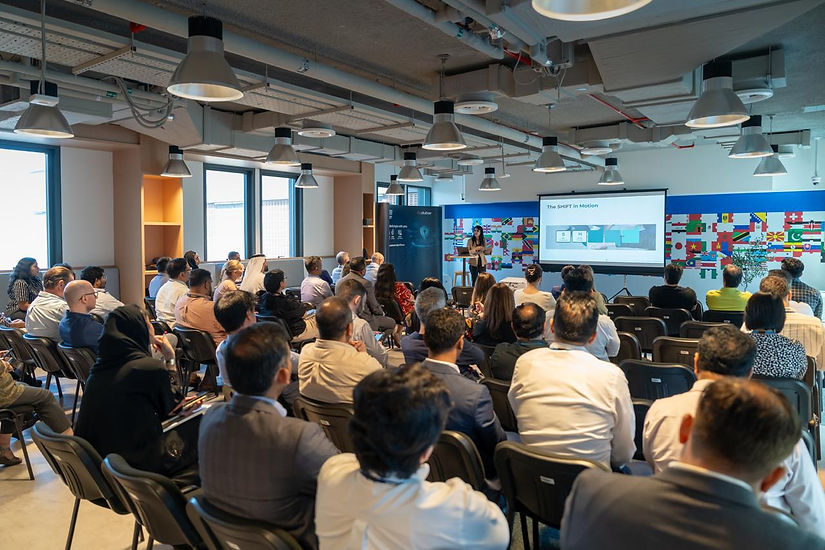
Harvard’s Mount Everest Virtual Simulation in the UAE & GCC
A Leadership and Team Simulation
Performance Under Pressure Reveals Leadership Reality
Harvard’s Mt. Everest Virtual Simulation is an award-winning leadership and team decision exercise developed by Harvard Business Impact (HBI).
The simulation is delivered through a digital simulation environment hosted on the Forio Epicenter platform, where participants engage in a structured, role-based expedition experience.
The simulation places participants into a realistic Mount Everest expedition scenario, where teams must reach the summit while managing limited resources, time pressure, and competing priorities.
Participants assume multiple expedition roles, each with unique information related to health conditions, oxygen levels, climbing pace, and operational decisions. Because information is distributed across the team, collaboration and communication become essential to success.
The simulation is used not as a classroom exercise but as a leadership performance lab.
The experience reveals how leaders and teams actually behave when:
Information is incomplete
Time pressure intensifies
Trade-offs must be made quickly
Stakeholder interests compete
The Mt. Everest Virtual Simulation typically runs for approximately ninety minutes, during which teams navigate a simulated expedition and respond to hidden challenges that affect their ascent, hiking speed, team health, and overall success.
This is not theory.
It is observable leadership performance under pressure.
Why Performance Breaks Under Pressure
Leadership capability is rarely tested in stable conditions.
Performance volatility typically emerges when:
Information becomes incomplete
Time constraints intensify
Objectives conflict
Authority is unclear
Authority becomes ambiguous
Stakeholders interpret risk differently
During the simulation, participants encounter hidden expedition challenges that affect climbing pace, team health, and resource allocation.


As pressure increases, underlying behavioral patterns often surface, including:
Decision dominance or decision withdrawal
Information hoarding between roles
Risk avoidance or excessive risk exposure
Communication breakdown
Fragmented team alignment
Harvard’s Mt. Everest Virtual Simulation makes these dynamics visible in real time.
At the organizational level, this reveals:
Decision discipline
Team interdependence
Accountability structures
Risk management behavior
Strategic prioritization
Pressure exposes leadership dynamics faster than discussion alone.


What the Mt. Everest Simulation Enables
The simulation places leaders into role-based expedition teams tasked with reaching the summit while balancing multiple operational constraints, including:
Oxygen levels
Resource allocation
Health indicators
Individual and team objectives
Collective expedition success
Through structured facilitation and guided debrief, organizations gain insight into how leadership and team behavior influence outcomes.
Decision-Making Patterns
How leaders analyze trade-offs and allocate limited resources under pressure.
Communication Flow
Where information bottlenecks emerge and how hierarchy affects participation.
Risk Tolerance
How individuals and teams evaluate uncertainty and exposure.
Alignment Discipline
Whether teams prioritize personal objectives or collective success.
Leadership Under Stress
How leadership behavior shifts as pressure and stakes increase.
The output is not a score.It is diagnostic clarity on leadership and team effectiveness.
Leadership and Team Learning Outcomes
Organizations use the Harvard Mt. Everest Virtual Simulation to strengthen leadership and team capability in several critical areas.
Participants experience how to:
Build, contribute to, and lead effective teams in complex environments.
Improve team decision-making processes under time pressure.
Understand how conflicting interests and unequal information influence team dynamics.
Observe how leadership behavior shapes team performance and outcomes.
Balance short-term task achievement with long-term team effectiveness.
Recognize how cognitive biases can impair judgment and decision quality.
.jpg)
These insights provide organizations with a clear view of how teams function when decisions must be made quickly and collaboratively.

Why Partner With Forward Training & Consulting
.png)
Certified Practitioners
Delivered by certified facilitators in Harvard’s Mount Everest Simulation and experienced in leadership development and team dynamics.

Harvard-Developed Simulation
An award-winning leadership simulation created by Harvard Business Impact (HBI) to strengthen team decision-making and leadership under pressure.

Performance-Focused Outcomes
Simulation sessions are aligned with organizational priorities to strengthen judgment, accountability, and execution discipline.

Building Capability.
Sustaining Performance.
Leadership effectiveness under pressure cannot be assumed. It must be examined and strengthened deliberately.
Forward Training & Consulting deploys Harvard’s Mt. Everest Virtual Simulation within enterprise capability frameworks across the UAE and GCC to reinforce decision discipline, strengthen leadership alignment, and stabilize execution under complexity.
If performance volatility increases as stakes rise, structured pressure testing becomes the starting point.
This work can be extended through other leadership development approaches depending on context, objectives, and constraints.
Related leadership development approaches include LEGO® SERIOUS PLAY®, with relevant assessment insights incorporated where appropriate.
Schedule a focused discussion to evaluate how simulation-based learning can support leadership decision-making and team performance.